

What Oakland’s 2026 Point-in-Time Count Revealed About Human Connection
January 22, 2026
“The hardest thing about being homeless is feeling invisible.”
That message, relayed by a member of Oakland’s unhoused community, stayed with the Oakland Housing Authority (OHA) staff who participated in Oakland’s 2026 Point-in-Time (PIT) Count, a nationwide effort led by the U.S. Department of Housing & Urban Development to estimate the number of people experiencing homelessness on a single night in January. The data collected through the count helps communities understand unmet needs and directs federal resources to local housing and support programs.
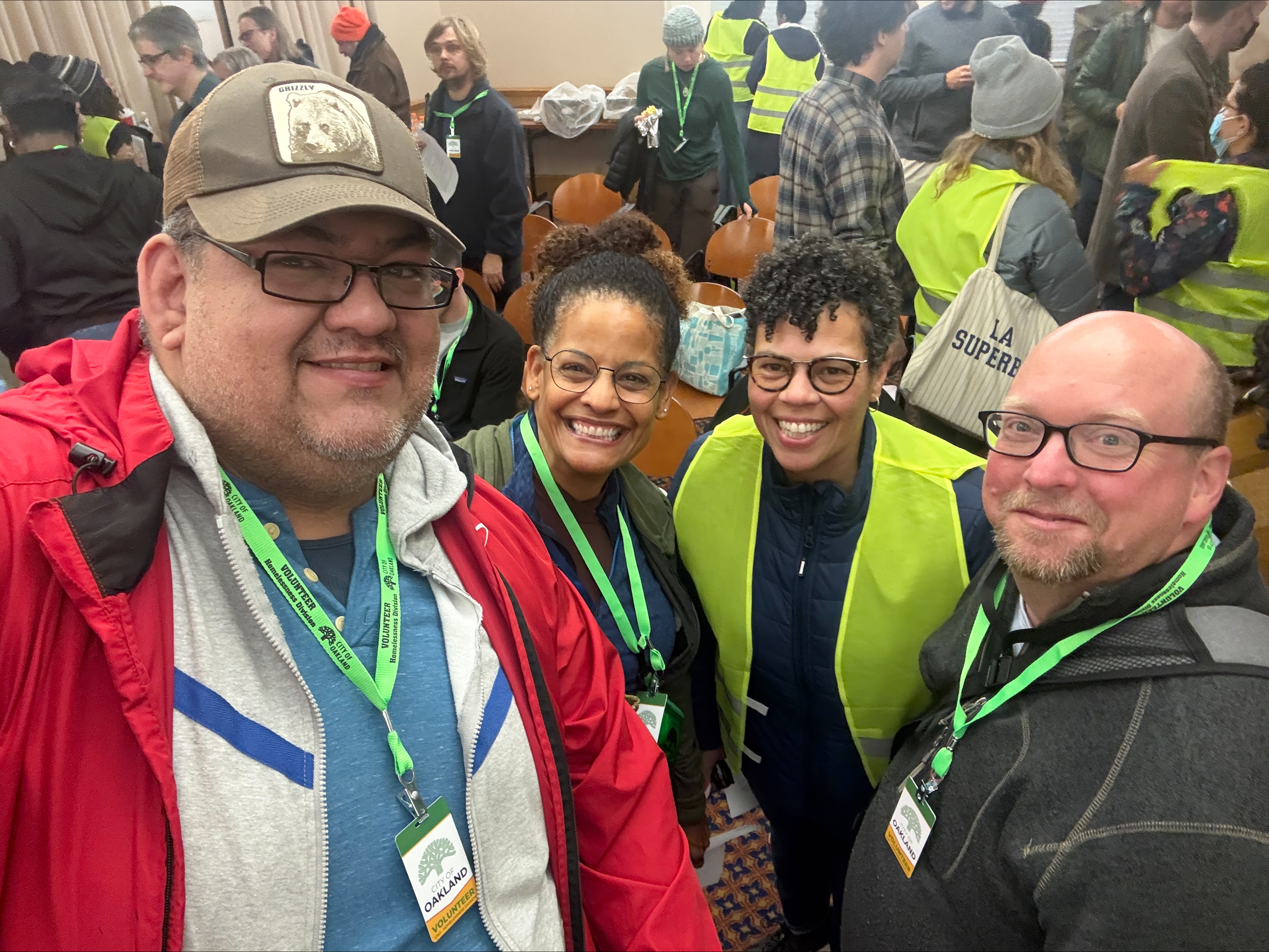
This year, members of the OHA team joined trained surveyors across the city, walking neighborhoods and meeting unhoused residents where they were — in parks, on sidewalks, and outside community spaces like the Lakeview Branch of the Oakland Public Library. Volunteers began gathering as early as 5 a.m., and the turnout was so strong that organizers quickly ran out of coffee.
In addition to participating as surveyors, OHA staff also mobilized resources to help support the effort, delivering essential supplies for the count. Their support helped relieve pressure on the City’s emergency operations teams, which were responding to the 1770 Broadway fire that had displaced Oakland families just days earlier.
During the survey, one resident named Don shared a perspective that left a lasting impression.
For many people experiencing homelessness, he explained, the most painful part isn’t just the loss of housing — it’s the feeling of becoming invisible to the world around them.
Sometimes, he said, the most meaningful thing someone can do is simply acknowledge another person’s presence.
“Just say something.”
Conversations like these highlight the complex factors that often contribute to homelessness. Many individuals described major life transitions — such as divorce, loss of employment, or personal crises — that led to housing instability and, in many cases, social isolation.
For OHA staff, participating in the PIT Count offered a powerful reminder that behind every data point is a human story.
While the PIT Count helps communities plan housing resources and services, it also reinforces a broader truth: addressing homelessness requires more than housing alone. It requires connection, compassion, and a commitment to seeing people as neighbors.
That belief continues to guide OHA’s work across Oakland — whether responding to emergencies, supporting residents through housing programs, or partnering with community organizations to expand access to stable housing.
Because sometimes, meaningful change begins with something simple: acknowledging one another and choosing to just say something.

Share


